
Skip to content Skip to footer

GBM – One of the Most Deadly Cancers

GBM continues to face limited treatment options and devastating survival rates.
AFCR is committed to accelerating breakthrough solutions.

The Urgent Need for Innovation

95%​

GBM kills 95% of patients within five years of diagnosis​

240,000​

Each Year, 240,000 People Worldwide Are Diagnosed with GBM​

15 Months​

The Median Survival for
Patients with GBM Less Than
15 months​

3 Drugs​

Over the Past 40 Years, Only 3 Drugs Have Been Approved for GBM, but They are Ineffective and With Significant Side Effects​

What We Need

Right Arrow

We Need

Left Arrow
Revolutionized Clinical Trial System
+
Global Platform
Down Arrow

Better & Effective Drugs

Down Arrow

Get to Cancer Patients Quicker

Down Arrow

High-Risk, High-Impact Cancer Trials

Down Arrow

Reduce Patient Resources & Costs

Why This Matters

A Platform for simultaneous testing of multiple therapies against a common standard​

Identifies effective therapies more efficiently and rapidly by reducing costs, time, and the number of patients required​

Potential to significantly shorten the discovery time for new biomarkers​

Collects overall survival data for international drug approval​

Accessible to all GBM patients, aiming for seamless trial and clinic integration​

Offers a novel research framework to address rare and lethal diseases​

AFCR's Role

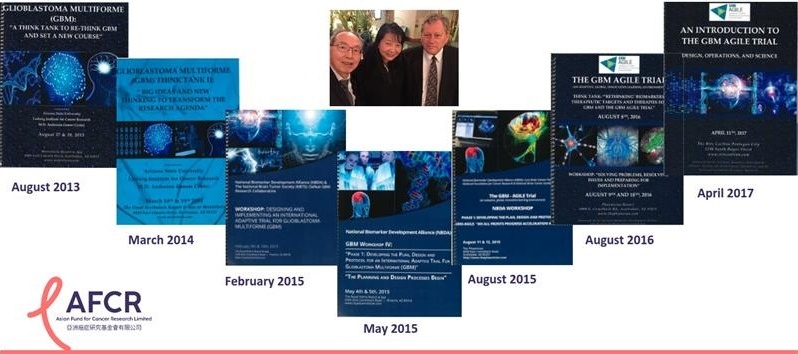
AFCR Leadership Were Among the Founding Leaders of GBM AGILE

Ongoing since 2018

A global clinical trial to allow more patients to quickly share benefits of more effective treatments

While there have been significant laboratory and clinical investigations into GBM over the years, the “standard-of-care treatment” – surgery, chemotherapy and radiation – has remained unchanged.

This troubling state of affairs for glioblastoma patients was the impetus for creating the GBM AGILE (GBM Adaptive Global Innovative Learning Environment) trial for patients with newly diagnosed and recurrent glioblastoma. AFCR has been supporting GBM AGILE since day one, from ideas to operation, in partnership with The Global Coalition for Adaptive Research (GCAR),  Cure Brain Cancer FoundationNational Foundation for Cancer Research, National Biomarker Development Alliance, and National Brain Tumor Society and other charities.

AFCR supports GBM AGILE by providing travel grants to Chinese scientists from eight major hospitals for them to attend the GBM AGILE workshops and press conference in the U.S.  AFCR also provides the travel grant to the US scientists to travel to China to attend the GBM AGILE related conference and works in China.

  • GBM AGILE is a revolutionary new type of “adaptive” trial platform, one that will evaluate and test multiple drugs simultaneously with the goal of identifying new and effective therapies to treat and cure this deadly brain
  • The trial will allow patients to enroll more quickly, receive treatment(s) based on each patient’s individualized response and does not require years of follow-up to determine whether a new experimental treatment is beneficial

By design, GBM AGILE is changing the IDEA of clinical trials.

Innovative – The new “adaptive trial” will lower cost of development and speed progress.

Dynamic – Perpetual learning system to quickly add potentially promising new drugs and drop those that appear to be ineffective.

Efficient – Design and trial structure that will require fewer patients and a shorter time frame to get important answers about a drug’s effectiveness.

Accessible – Global effort open to a broad patient population of newly diagnosed and recurrent GBM patients.AFCR supports GBM AGILE, recognizing it as being among the most innovative and paradigm-shifting trial platforms in the world, and one that may provide huge impacts for brain cancer patients.

Significantly, the knowledge and the trial design platform established from GBM AGILE can be a model to be used for other rare and deadly cancers – giving cancer patients hope for treatments that are best suited for their care. Click here to read the latest update on the clinical trial patient recruitment plan.