AFCR’s Continuing Role in Hong Kong’s Biomedical Innovation Ecosystem
A Look Back: 2022 – 2026
2022: Asking an Important Question
In 2022, the Asian Fund for Cancer Research Limited (AFCR) convened a multidisciplinary Think-Tank Forum at BIOHK around a forward-looking question: What would it take for Hong Kong to realize its potential as a globally important biomedical innovation hub – and translate its scientific strengths into greater benefits for patients?
The discussion brought together leaders and experts from academic and clinical research, biotechnology and investment in Hong Kong and the United States. Rather than focusing only on research funding, the group examined the broader ecosystem required to move promising discoveries from laboratories toward clinical development, commercialization and patient impact.
The resulting white paper, “Unlocking the Potential of Hong Kong as a Biomedical Innovation Hub,” was intended to identify gaps and opportunities and to offer practical ideas for strengthening Hong Kong’s biomedical innovation ecosystem.
What We Saw Then
The Think Tank recognized Hong Kong’s considerable assets: world-class universities and researchers, an international financial center, growing biotechnology capabilities, proximity to the Greater Bay Area, and a distinctive position connecting Mainland China with the international community.
At the same time, participants identified a fundamental challenge: scientific excellence alone does not create a biomedical innovation ecosystem.
The report highlighted the need for stronger translational research capabilities; greater collaboration among universities, hospitals, industry and investors; stronger entrepreneurship and commercialization infrastructure; greater availability of early-stage capital; expanded clinical research capabilities; and stronger international collaboration.
Importantly, the discussion looked beyond individual programs toward an interconnected ecosystem capable of moving innovation forward.
From Identifying Gaps to Proposing Solutions
The 2022 report proposed several practical directions, making life sciences and technology a strategic priority:
- strengthening basic and translational research;
- encouraging international collaboration;
- improving technology transfer and commercialization across institutions;
- developing entrepreneurship and drug-development talent;
- creating mechanisms to help investors evaluate biomedical opportunities;
- building public-private funding partnerships capable of supporting early-stage biotechnology companies.
Hong Kong did not simply need more excellent science.
It needed stronger connections between discovery, translation, entrepreneurship, capital, clinical development and patients.
Hong Kong needed an ecosystem with integrated efforts from all stakeholders.
Download 2022 Think-Tank Forum White Paper…
2026: Encouraged by the Direction Hong Kong Is Taking
Four years later, it is encouraging to see many of these broad priorities receiving substantially greater attention in Hong Kong’s evolving innovation strategy, including in its new Five-Year Plan.
The significance for AFCR is that we had the foresight to recognize these needs early and have maintained our commitment to advancing them over time.
Hong Kong’s biomedical ecosystem has been shaped by government, universities, researchers, clinicians, entrepreneurs, investors, industry and many other organizations over many years.
The discussions at BIOHK 2022 provide an important perspective: many of the challenges that AFCR and its partners identified early have since moved closer to the center of Hong Kong’s biomedical innovation agenda.
For AFCR, this convergence reinforces our long-held conviction that strengthening the connections between research, translation, capital and patients is essential to realizing Hong Kong’s biomedical potential.
AFCR’s Role: Convene, Connect and Catalyze
AFCR’s seed role is a catalyst for government, universities, venture investors or biotechnology companies. Its distinctive value can lie in the role connecting gaps and spaces between those institutions.
As an independent nonprofit organization focused on cancer research and innovation, AFCR can convene stakeholders who do not ordinarily sit at the same table; identify promising science before it attracts conventional investment; help bridge translational funding gaps; connect researchers with entrepreneurial and investment expertise; facilitate international collaborations; and keep the ultimate objective – improving outcomes for patients – at the center of innovation.
That role was already visible in the 2022 Think Tank, whose concluding vision brought together academic institutions, biopharmaceutical companies, hospitals and patients, research organizations, investors and other stakeholders in a collaborative biomedical innovation ecosystem.
A Continuing Journey
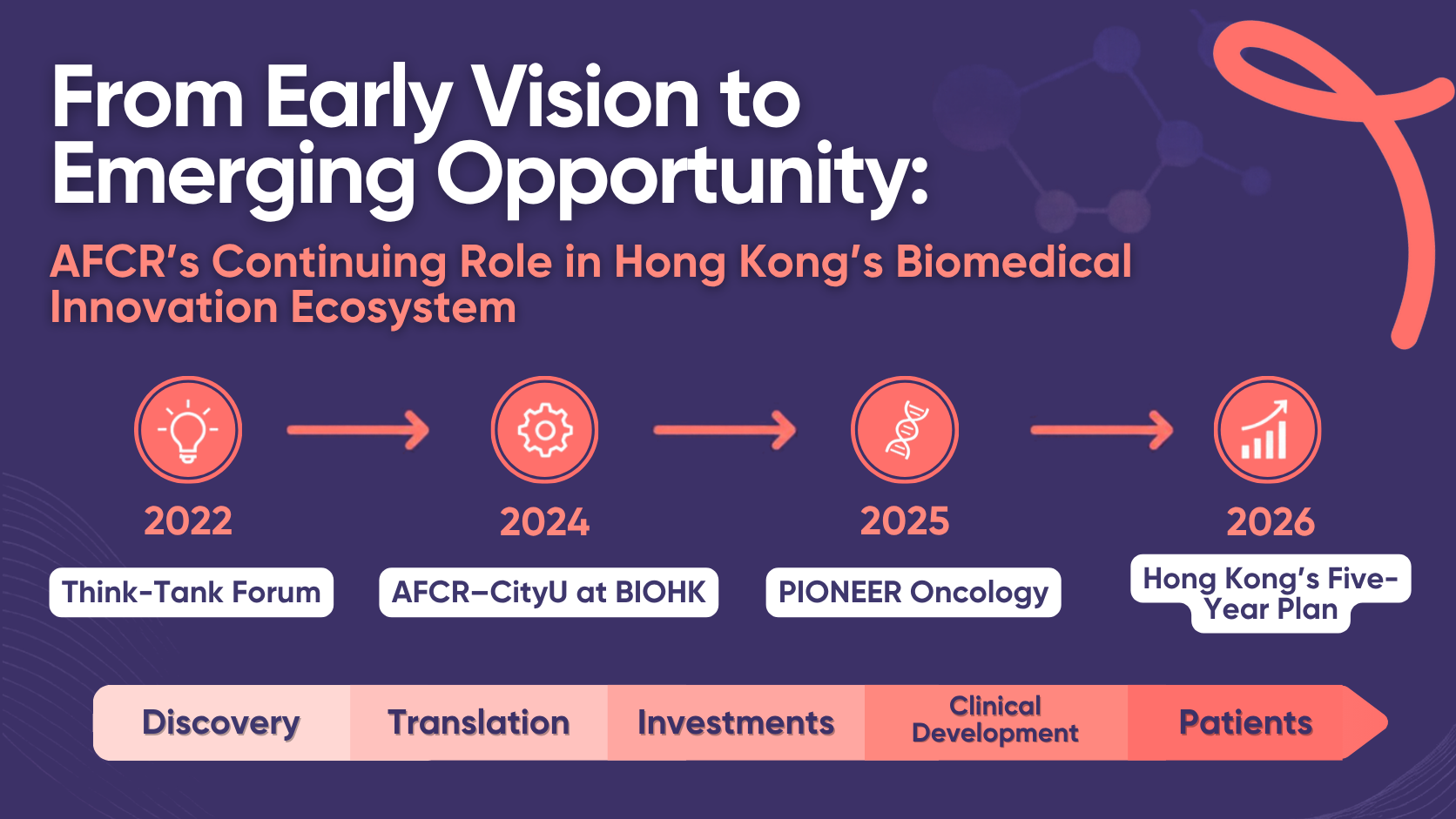
| 2022 | CONVENE – AFCR brings together science, clinical, biotech and investment leaders to identify Hong Kong’s gaps and opportunities. |
| 2022 | RECOMMEND – The Think Tank proposes stronger translation, commercialization, entrepreneurship, clinical research and public-private capital. |
| 2024 | CONTINUE THE DIALOGUE: TRANSLATING DISCOVERIES TO THE MARKETPLACE – AFCR continues convening leaders as Hong Kong’s biomedical ecosystem evolves. |
| 2026 | ALIGN WITH A NEW MOMENT – Hong Kong’s Five-Year Plan gives greater strategic attention to biomedical innovation, translation and commercialization. |
| Looking Ahead | HELP TURN STRATEGY INTO PATIENT IMPACT – AFCR continues building bridges across discovery -> translation -> capital -> clinical development -> patients. |
Looking Forward: Why This Moment Matters
Hong Kong today has an important opportunity to build on its scientific excellence, financial capabilities and unique international position. The policy environment is increasingly focused on the difficult middle ground between discovery and impact – precisely where collaboration, translational support, entrepreneurship and patient-oriented innovation become critical.
For AFCR, the question is therefore no longer simply whether Hong Kong can become an important biomedical innovation hub. It is:
How can AFCR help ensure that promising discoveries move through the innovation ecosystem – and ultimately reach the patients who need them?
This is the work AFCR intends to continue: serving as a convener, connector and catalyst; supporting high-impact cancer research and translation; linking scientific innovation with capital and expertise; and helping keep patient benefit at the center of the biomedical innovation journey.