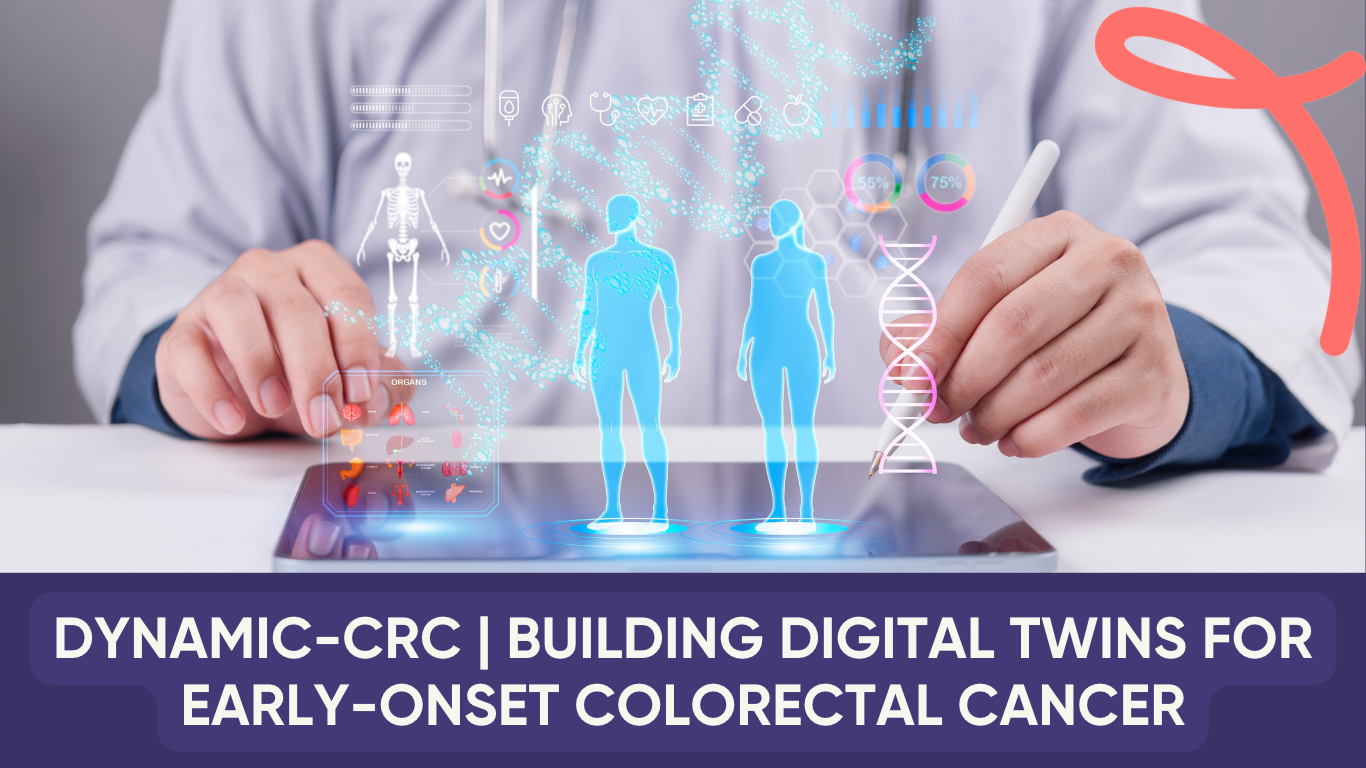
Building Digital Twins for Early-Onset Colorectal Cancer
THE CHALLENGE: A GROWING THREAT TO THE NEXT GENERATION
A colorectal cancer diagnosis can upend any life. For someone in their 20s, 30s or 40s, it can also interrupt decades of plans, work and family life.
Asia accounted for approximately half of all new colorectal cancer cases worldwide, with incidence rates rising faster among younger individuals. In Hong Kong, colorectal cancer is reported as the most common cancer among men aged 20–49. In 2023, 5,467 people in Hong Kong were diagnosed with colorectal cancer and 2,266 died from it.
The need is particularly pressing for younger patients, who are generally outside Hong Kong’s routine government colorectal screening age range.
THE TREATMENT GAP: WHY BETTER PREDICTIONS MATTER
Many colorectal cancers are microsatellite stable (MSS). Although doctors use established treatments and clinical information to guide care, predicting which treatment will benefit a particular patient remains difficult. If a therapy is ineffective, patients may experience side effects while losing valuable time.
Imagine a 35-year-old parent facing treatment decisions while trying to protect a young family’s future. More precise predictions could one day help doctors make better-informed choices earlier.
THE SCIENTIFIC OPPORTUNITY: A DIGITAL TWIN OF A PATIENT’S CANCER
DYNAMIC-CRC proposes to develop and study personalized computational models—often called digital twins—using information such as tumor molecular characteristics, blood tests, medical images and clinical history.
The research will investigate whether these models can forecast treatment response, improve as new patient data become available, and ultimately help researchers identify more effective ways to guide care. These are goals to be tested, not capabilities already established for routine patient treatment.
SCIENTIFIC LEADERSHIP | A proposal ready for support
Conceived by leaders in cancer research and approved by AFCR’s Scientific Advisory Board, DYNAMIC-CRC brings together an urgent clinical problem and an innovative research approach. The project is proposed and has not
yet launched. Donor support is needed to help initiate the work.
Learn more about AFCR’s research focus areas
THE RESEARCH PATH: FROM SCIENTIFIC IDEA TO EVIDENCE
The proposed work builds on the research team’s earlier molecular-twin approach in pancreatic cancer. The applicability of that approach to early onset colorectal cancer still needs to be established through research.
Across a proposed three-year research period, the team aims to:
- Assemble a detailed, appropriately governed research dataset focused
on younger people with colorectal cancer. - Develop and refine a working computational model using molecular and
clinical information. - Evaluate how accurately the model predicts treatment response and
whether the findings justify larger clinical studies.
Success at this stage would mean producing credible evidence for further testing—not demonstrating that the model is ready for routine hospital use. Any later clinical testing in Hong Kong or elsewhere in Asia would require appropriate scientific, ethical and regulatory review.
THE FUNDING NEED: HELP LAUNCH THE RESEARCH
DYNAMIC-CRC is a proposed three-year initiative with an estimated total budget of HK$18.7 million. It has not yet launched. AFCR is seeking philanthropic support to help begin and sustain this important research.
Your gift can help make possible the foundational work needed to develop research data resources, build and evaluate the proposed models, and prepare evidence for subsequent studies.
THE HUMAN REASON: PROTECT THE NEXT GENERATION
For a young adult with cancer, better treatment decisions are about far more than technology. They are about the possibility of more time with children, parents and loved ones—and more years to pursue a future that should not
be cut short.