What does it take to turn a scientific breakthrough into something that can truly change a patient’s life?
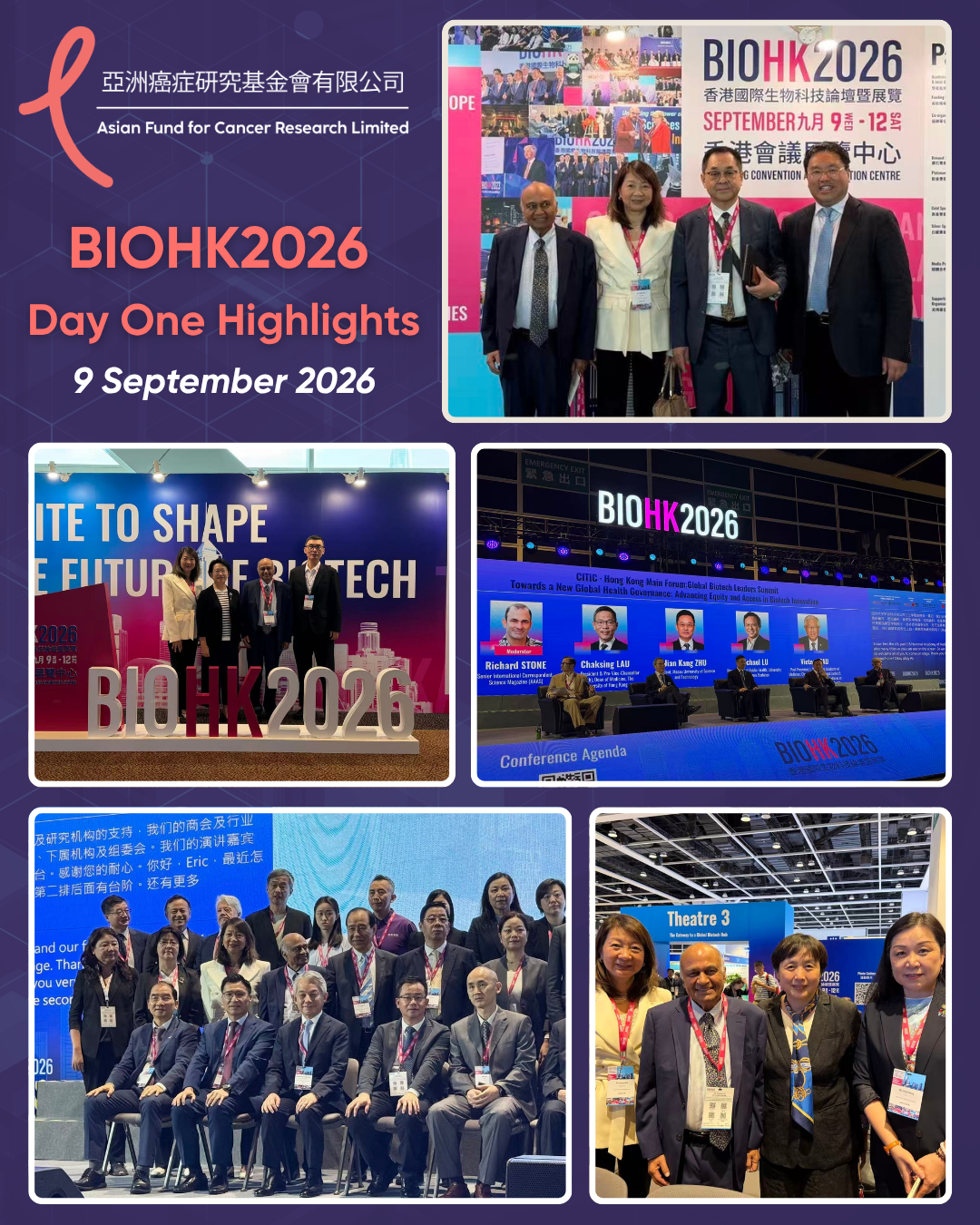
That question ran through many of the conversations on Day One of BIOHK2026 in Hong Kong.
Dr. Sujuan Ba, President, CEO, and Founder of the Asian Fund for Cancer Research Limited (AFCR), represented AFCR at BIOHK2026 as one of the supporting organizations actively promoting innovations to benefit patients in Hong Kong and globally.
Across the opening remarks, speakers highlighted Hong Kong’s growing role as a connector and value-adder—linking research, clinical development, regulation, capital and talent across the Greater Bay Area and the international life-science community. For cancer research, these connections matter because promising discoveries rarely reach patients through science alone. They also depend on strong clinical, regulatory and translational pathways.
Advancing Earlier Cancer Detection
One of the day’s most compelling cancer-focused presentations came from Prof. Yuk-Ming Dennis Lo, Vice-Chancellor and President of The Chinese University of Hong Kong, who discussed advances in cell-free DNA and fragmentomics.
Cell-free DNA circulating in the bloodstream can provide a non-invasive window into cancer. Fragmentomics examines how these DNA fragments are broken into pieces—including their size, ends and other characteristics—to uncover biological information that may help distinguish tumor-derived DNA from background DNA.
These advances are helping researchers move toward increasingly informative, minimally invasive approaches to earlier and more accurate cancer detection.
Prof. Victor J. Dzau, former President of the U.S. National Academy of Medicine, also highlighted how AI, genomics and biotechnology are converging across prevention, discovery and treatment, including advances such as immunotherapy and CAR T-cell therapy. His presentation underscored an important challenge: scientific breakthroughs only create meaningful impact when they can be manufactured, regulated and delivered in ways that patients can access.
Innovation Must Advance Responsibly
The panel discussions pushed the conversation beyond what new technologies can achieve.
One important question was how scientific innovation and responsible innovation can advance together.
As AI, gene editing and other powerful technologies move forward, progress must also be safe, trustworthy and equitable. That means asking not only what science can do, but how data are used, how risks are managed, whether patients can benefit fairly, and how international scientific collaboration can be protected even in a more complicated global environment.
For organizations supporting cancer research, these questions are increasingly important. Moving discoveries toward patients requires not only speed and scientific ambition, but also trust, strong evidence and responsible pathways for translation.
Hong Kong as a Biotech Bridge
Another panel explored Hong Kong’s role as a practical biotech bridge—connecting international standards, capital and expertise with the clinical, manufacturing and innovation resources of the Greater Bay Area.
The discussion emphasized that connectivity alone is not enough. Credible regulation, transparent clinical data, commercialization capability, international expertise and talent are all needed to translate scientific advances into clinical and patient impact.
For AFCR, the message from Day One is clear:
Progress does not end with discovery.
It depends on whether promising science can move responsibly from the laboratory into clinical development—and ultimately reach the patients who need it.
That is the path AFCR remains committed to helping advance: supporting promising cancer research, encouraging collaboration, and helping innovation move toward better outcomes for patients in Hong Kong, across Asia and globally.
Learn more about AFCR Symposium at BIOHK…