Cell and gene therapies are advancing rapidly. But scientific progress alone is not enough. The next challenge is building the clinical, manufacturing and regulatory systems needed to bring these therapies into wider use safely and effectively, with better outcomes for patients.
At the AFCR Symposium at BIOHK2026, researchers, clinicians and biotechnology leaders explored the practical questions shaping the field—from T-cell therapy and gene editing to local manufacturing, AI-enabled GMP systems, regenerative medicine and precision oncology.
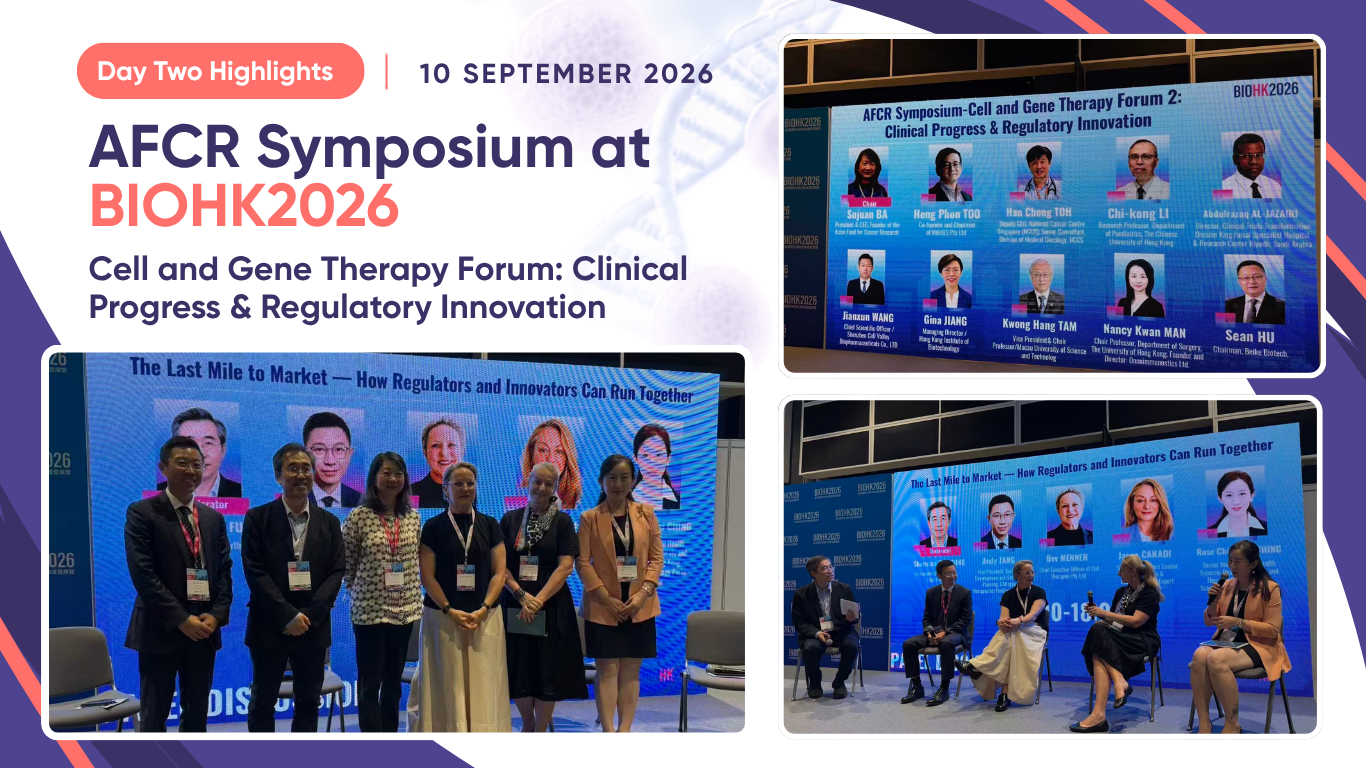
Chaired by Dr. Sujuan Ba, Founder, President and CEO of the Asian Fund for Cancer Research Limited (AFCR), the symposium looked beyond what emerging therapies can do to examine what it will take to manufacture them reliably, navigate regulatory pathways and bring them into broader clinical use while protecting patient safety and improving outcomes.
Highlights from the Symposium
Turning Scientific Ideas into Biotechnology Ventures
Prof. Heng Phon Too, Co-founder and Chairman of MiRXES Pte Ltd, shared how two university spinouts took different paths from research to application: one using microRNA and machine learning for cancer detection and monitoring, and another developing a stem-cell “hunter-killer” approach for recurrent brain tumors. The experience also highlighted the challenge of scaling biotech beyond Singapore’s relatively small domestic market.
Refining T-Cell Therapy for Greater Precision
Dr. Han Chong Toh, Deputy CEO of the National Cancer Centre Singapore (NCCS) and Senior Consultant in its Division of Medical Oncology, explored how approaches such as IL-15 enhancement, dual targeting and biomarker selection may improve T-cell response and help overcome resistance. He also addressed the opportunities and risks of extending CAR T-cell therapy beyond blood cancers and simplifying current manufacturing models.
Strengthening Cell and Gene Therapy Capacity in Hong Kong
Prof. Chi-kong Li, Research Professor in the Department of Paediatrics at The Chinese University of Hong Kong, described a point-of-care CAR T-cell manufacturing program in Hong Kong that shortened production from several weeks to around two weeks. He also outlined a Greater Bay Area collaboration developing a more accessible gene therapy pathway for beta-thalassemia.
Building a Stronger Clinical Trials Ecosystem
Dr. Abdulrazaq Al-Jazairi, Director of the Clinical Trials Transformation Division at King Faisal Specialist Hospital & Research Centre in Riyadh, Saudi Arabia, outlined Saudi Arabia’s efforts to strengthen its clinical-trial ecosystem through faster regulatory pathways, expanded GMP capacity and closer coordination among hospitals, regulators and industry. He also highlighted growing local capabilities in stem cells, CAR-T and gene editing.
Engineering CAR-NK Cells with CRISPR
Dr. Jianxun Wang, Chief Scientific Officer of Shenzhen Cell Valley Biopharmaceuticals Co., Ltd., introduced an engineered virus-like particle platform designed to deliver gene-editing tools such as Cas9 without carrying viral genetic material. The platform is being explored for gene knockouts and CAR engineering, with scalability built into the manufacturing model.
Bringing AI into GMP Manufacturing
Gina Jiang, Managing Director of the Hong Kong Institute of Biotechnology, explored how AI could be introduced into GMP manufacturing through applications such as predictive maintenance, smart logistics, AI-assisted SOP development and automated batch-record review. Her approach emphasized starting with lower-risk operations first to build regulatory confidence.
Exploring Regenerative Medicine for Liver Disease
Prof. Kwong Hang Tam, Vice President and Chair Professor at Macau University of Science and Technology, described how organoid-based platforms are being used to study liver disease, test drug-repurposing strategies and explore regenerative approaches. He also discussed work involving intestinal organoid transplantation and the longer-term development of more complex regenerative systems.
Building Patient-Specific Models for Precision Oncology
Prof. Nancy Kwan Man, Chair Professor in the Department of Surgery at The University of Hong Kong and Founder and Director of Oncoimmunostics Ltd., presented a 3D patient-derived liver cancer platform designed to recreate aspects of an individual tumor environment and help evaluate which treatment options may be most effective within a clinically relevant timeframe. The platform is also being explored for other disease models and new approaches to therapeutic delivery.
Exploring New Regulatory and Manufacturing Pathways
Sean Hu, Chairman of Beike Biotech, discussed the role of Hainan Boao Lecheng as a regulatory pilot zone for selected stem-cell, immune-cell and gene-therapy technologies. He also highlighted Beike Biotech’s efforts to expand automated production capacity and develop more distributed manufacturing models.
Building the Systems to Scale
The symposium concluded with “The Last Mile to Market — How Regulators and Innovators Can Run Together,” moderated by Sherman K.W. Fung, Co-Founder and CEO of North Edge Ltd.
Panelists included:
- Andy Zang, Vice President, Business Development and Strategic Planning, CARsgen Therapeutics Holdings Limited
- Bev Menner, Chief Executive Officer, Cell Therapies Pty Ltd
- Jasna Canadi, Senior Life Science Leader, Bioanalytics & Immunogenicity Expert
- Rose Ching Kei Ching, Senior Manager, Life and Health Science, Pharmaceuticals and Therapeutics, Hong Kong Science and Technology Parks Corporation
The discussion focused on the early decisions and coordination needed to help cell and gene therapies move successfully toward wider use. Panelists emphasized that developers, manufacturers and regulators need to work together from the start, with manufacturing, supply chains and regulatory planning integrated into the development process.
AI and robotics were another recurring theme, with potential to reduce manufacturing costs, identify production problems earlier and improve regulatory processes. At the same time, panelists emphasized that innovation must remain grounded in strong evidence, human oversight and patient safety, particularly as increasingly complex therapies move toward wider clinical use.
The next frontier is not only developing more powerful therapies. It is creating the systems needed to evaluate, produce and deliver them safely for broader clinical use—with better outcomes for patients as the ultimate goal.
Through the AFCR Symposium at BIOHK2026, AFCR brought together experts from across this evolving field to examine the practical challenges that will shape the next generation of cancer and biotechnology innovation—and help promising research to move forward safely and responsibly.
Learn more about AFCR Symposium at BIOHK…