Cancer science is creating new possibilities at an extraordinary pace, but the need for progress continues to grow.
In Hong Kong, about 40 people die from cancer every day. Worldwide, approximately one in five people will develop cancer during their lifetime, with annual new cancer cases projected to approach 35 million by 2050 [1].
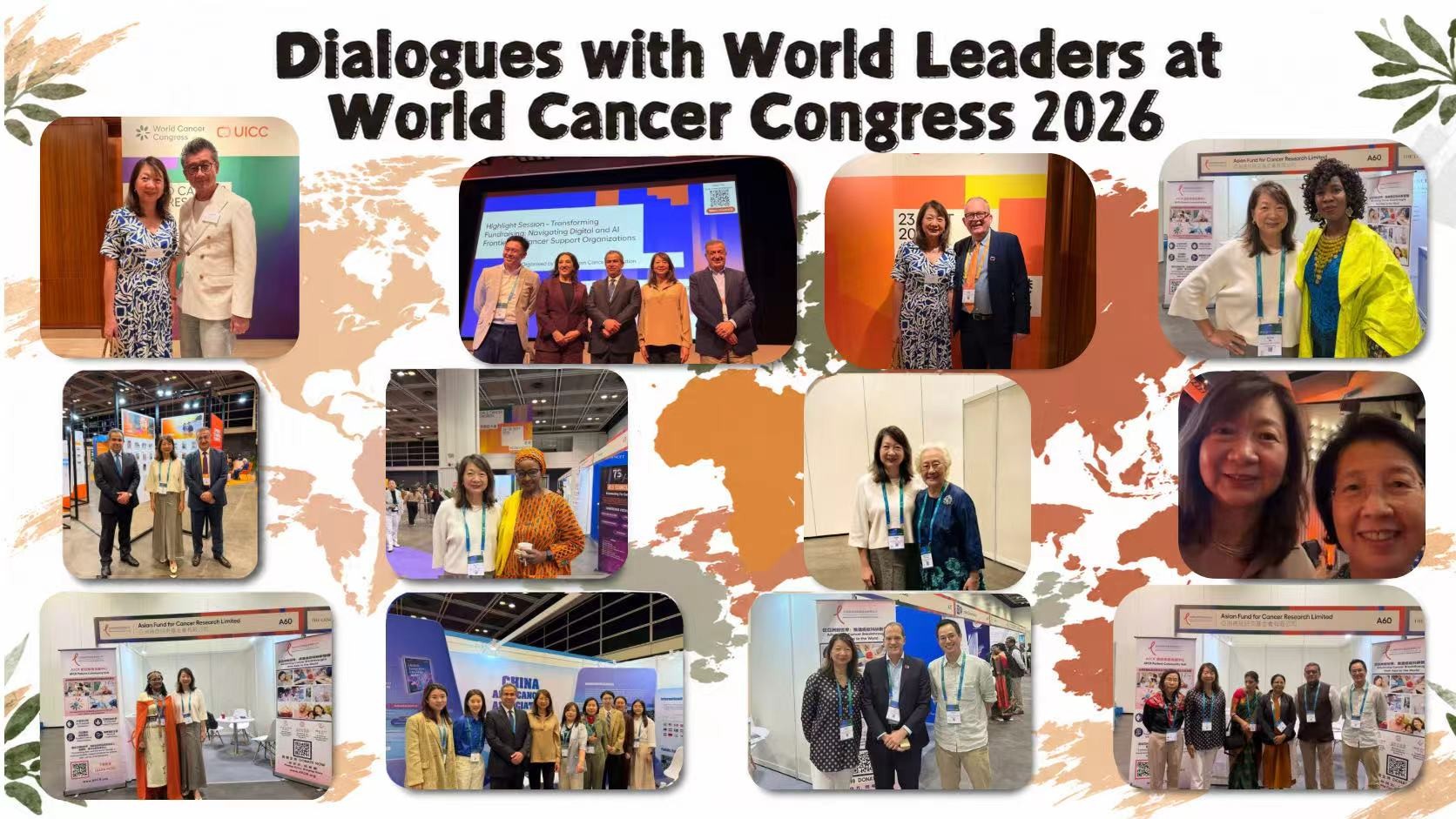
World Cancer Congress 2026 in Hong Kong brought this urgency into focus, gathering more than 2,000 delegates from 124 countries, including researchers, clinicians, policymakers, patient organizations, advocates and other leaders working across cancer prevention, research, treatment and care.br
Dr. Sujuan Ba, Founder, President and CEO of the Asian Fund for Cancer Research Limited (AFCR), participated in the Congress as part of this global exchange.
Across three days of discussion, a common challenge came into focus: cancer science continues to create new possibilities, but discovery alone does not determine patient outcomes. Progress also depends on detecting cancer earlier, translating promising research into effective treatments, building health systems capable of delivering innovation, and ensuring that advances reach the people who need them.
Earlier Detection Remains a Critical Priority
Earlier detection remains one of the greatest opportunities to improve cancer outcomes.
At the Congress, speakers noted that approximately half of cancers are currently detected at an advanced stage, when treatment becomes more difficult and survival often declines. Prevention, screening and earlier diagnosis therefore remain essential to improving cancer outcomes and reducing the burden on health systems.
But earlier detection is not simply a matter of developing better tests. People need to recognize warning signs, healthcare professionals need effective pathways for screening and follow-up, and patients need support when results raise new questions. Discussions around lung cancer screening, for example, highlighted the importance of public and professional awareness as well as nursing support to help people understand findings and navigate next steps.
At the same time, genomics, integrated health records and emerging blood-based approaches are opening possibilities for identifying risk and disease sooner. These advances point toward a more proactive model of cancer care—one that seeks to understand risk earlier and intervene before cancer becomes more difficult to treat.
Precision Oncology: From Possibility to Practice
Precision oncology is changing how some cancers are understood and treated.
By using the molecular and genetic characteristics of a tumor to guide treatment decisions, precision oncology can help match certain patients with therapies directed at specific cancer-related alterations. The Congress highlighted the impact of biomarker-driven therapies, particularly in diseases such as lung cancer, where targeted treatments and immunotherapy have expanded treatment possibilities.
Yet the scientific breakthrough is only one part of the journey.
For precision oncology to reach patients, molecular testing must be available, clinical and regulatory systems must operate efficiently, healthcare professionals need the right infrastructure and expertise, and treatments must be accessible.
The Congress highlighted practical barriers that can slow this path, including regulatory delays in diagnostic tools used for precision-oncology clinical trials.
This is the broader challenge of translational research: moving a promising discovery from the laboratory through validation, clinical development and implementation until it can meaningfully change patient care.
AI Is Expanding Possibilities — but Data Comes First
Artificial intelligence is beginning to influence many parts of cancer research and care, from risk prediction and diagnosis to treatment planning and clinical research.
Its potential is closely tied to another major development: the growing amount of genomic, clinical and real-world health data available to researchers and healthcare systems. When these sources can be brought together effectively, AI may help identify patterns that would otherwise be difficult to see, support more personalized treatment decisions and improve the efficiency of research.
Reliable, integrated health information is part of the infrastructure needed for AI to contribute meaningfully to cancer care. And access matters just as much as technical capability. If advanced tools are available only to health systems with extensive resources and data capacity, technology could reinforce rather than reduce existing disparities.
The same principle extends beyond AI. Targeted therapies, immunotherapy, CAR-T cell therapy and mRNA technologies are all creating new possibilities, but cost and differences in health-system capacity continue to affect who can benefit from them.
Innovation creates possibilities. Data, infrastructure and implementation determine whether those possibilities become part of everyday cancer care.
Closing the Gap Between Innovation and Access
One of the strongest themes running through the Congress was the distance that can still exist between scientific progress and patient access.
Cancer care depends on an entire system: screening and diagnostics, trained healthcare professionals, treatment facilities, medicines, supportive services and sustainable financing. A breakthrough can have limited impact if any of those pieces are missing.
Health-equity discussions emphasized that the financial challenge extends far beyond the price of a medicine. Diagnostic capacity, medical training, infrastructure and follow-up care all shape whether patients can benefit from advances in cancer science.
The question for cancer research is therefore no longer only “What can science make possible?” It is also “What will it take for that progress to reach patients?” That second question requires collaboration across research, clinical care, health systems, policy and communities.
Patients and Caregivers Bring Essential Expertise
Progress also cannot be measured by technology alone. People living with cancer and those who care for them bring knowledge that cannot be captured entirely through clinical data or research studies.
Congress discussions on lived-experience leadership examined how patients, survivors and caregivers can move from being consulted or invited to tell their stories toward having meaningful influence in research, healthcare systems and decision-making. Panelists emphasized that visibility is not the same as participation, and that lived experience can bring expertise alongside scientific and clinical perspectives.
Ultimately, the value of cancer research is measured not only by what is discovered, but by how those discoveries improve the experiences and outcomes of people affected by cancer.
Hong Kong’s Growing Role in Health and Biomedical Innovation
Hosting the World Cancer Congress also highlighted Hong Kong’s evolving role in health and biomedical innovation.
Priorities highlighted included expanding clinical trials, advancing biotechnology and precision medicine, accelerating the development and evaluation of drugs and medical devices, and strengthening cooperation with mainland China and across the Guangdong-Hong Kong-Macao Greater Bay Area.
Hong Kong is also continuing to develop genomic medicine, electronic health infrastructure and applications of artificial intelligence in healthcare, alongside attention to coordination, ethics and patient safety.
For cancer research organizations working across Asia, this evolving environment creates opportunities to strengthen international collaboration and help promising research move closer to clinical application.
Read more about AFCR’s continuing role in the biomedical innovation ecosystem.
Collaboration Turns Progress into Impact
No single organization, institution or country can address the global cancer burden alone.
That message ran throughout World Cancer Congress 2026 and returned in its closing discussions, where participants were encouraged to carry what they had learned back to their own countries and organizations and turn shared ideas into practical action.
Dr. Ba also participated in a Congress panel examining how digital technologies and AI are changing the way cancer organizations engage communities and mobilize resources. In her remarks, she connected these tools back to the broader mission of advancing cancer research, supporting the translation of discoveries and ultimately benefiting patients.
The connection—from resources to research, from research to translation, and from translation to patients—reflects the broader challenge highlighted throughout the Congress.
From Progress to Impact
World Cancer Congress 2026 highlighted both how far cancer research has advanced and how much work remains.
Earlier detection, precision medicine, artificial intelligence and new treatment approaches are expanding what may be possible for patients. But scientific progress must be accompanied by strong health systems, accessible care, meaningful patient involvement and collaboration across sectors.
At AFCR, we support research aimed at finding cancer earlier and developing more effective treatments. We also help promising discoveries move from the laboratory toward clinical studies—the essential step in determining whether a new approach can safely and effectively help patients.
For a family facing cancer, a discovery’s true value is the difference it may eventually make in their loved one’s life. That is why we work to help research move closer to patients.
Help accelerate progress against cancer.
Reference:
[1] https://www.who.int/news/item/08-07-2026-who-calls-for-urgent-action-as-new-cancer-cases-are-projected-to-nearly-double-by-2050