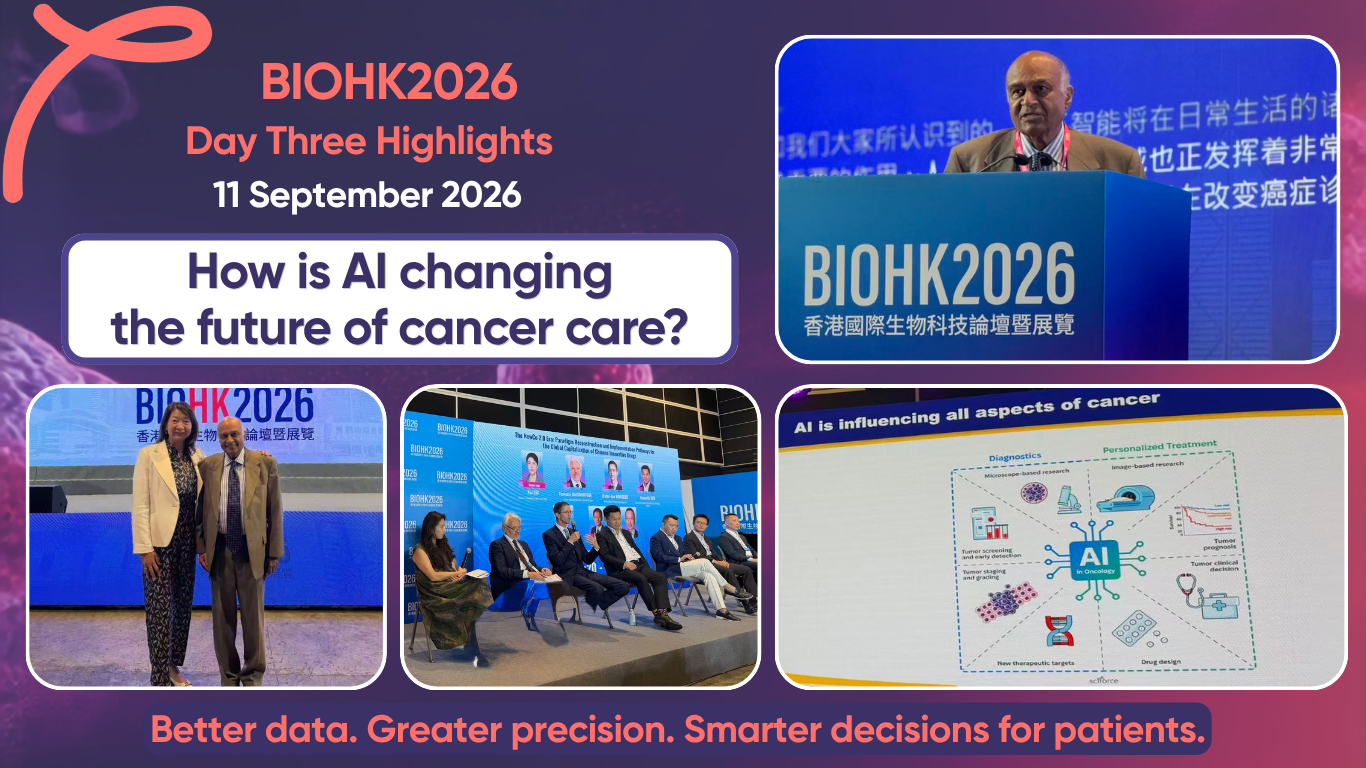
The Day Three day of BIOHK2026 turned attention toward two forces increasingly shaping the future of cancer research: artificial intelligence and the globalization of biotechnology.
A major highlight was a presentation by Prof. Raju Kucherlapati, Paul C. Cabot Professor of Genetics and Professor of Medicine at Harvard Medical School, member of the U.S. National Academy of Medicine, and Scientific Advisor to AFCR. His presentation explored how AI and genomic data are opening new possibilities across the cancer care pathway—from identifying people at higher risk to detecting disease earlier and helping guide more personalized treatment decisions.
Using AI to See Cancer Earlier and More Clearly
Prof. Kucherlapati traced the evolution of cancer care from surgery, radiation and chemotherapy toward an era increasingly shaped by precision medicine and AI-assisted decision-making.
AI is already being explored across many areas of oncology, including diagnostic imaging, pathology, cancer-risk prediction, treatment selection and drug discovery. Examples discussed included using electronic health records to identify people at higher risk of pancreatic cancer and using AI to detect abnormalities in medical images before clinical symptoms appear.
These approaches point toward a future in which clinicians may be able to recognize cancer risk earlier and make treatment decisions using a much broader picture of each patient.
Genomics Makes Precision Possible
Prof. Kucherlapati also highlighted the lasting impact of the Human Genome Project and large cancer-genomics initiatives such as The Cancer Genome Atlas (TCGA).
Falling sequencing costs and increasingly rich genomic datasets are enabling researchers to characterize cancers in much greater molecular detail. These insights can help better understand individual tumors and support more personalized treatment decisions.
The impact of precision medicine is already visible in diseases such as non-small cell lung cancer, where advances in molecular understanding and targeted treatments have transformed the treatment landscape over the past two decades.
Looking Beyond Discovery: How Innovation Moves Globally
Another Day Three session examined a different part of the innovation pathway: how emerging biotechnology companies can bring scientific advances into global development.
Moderated by Xin Liu, Director of Healthcare Fund at Hony Capital, the panel, “The NewCo 2.0 Era: Paradigm Reconstruction and Implementation Pathways for the Global Capitalization of Chinese Innovative Drugs,” brought together leaders from investment, pharmaceutical partnering, biotechnology and law to examine how Chinese biotech companies are evolving their global development strategies.
The discussion emphasized that scientific quality is only one part of successful global development. Strong clinical strategy, regulatory planning, experienced management, differentiated assets and international partnerships are also critical. Panelists also discussed the shift from single-asset companies toward platform-based models that can support multiple programs and more flexible development strategies.
For cancer innovation, these considerations are increasingly relevant as emerging technologies such as T-cell engagers and next-generation cell therapies move through increasingly complex development and commercialization pathways.
From Precision to Patient Impact
Day Three’s highlights pointed to a broader shift in cancer innovation. AI and genomics are helping researchers understand cancer with greater precision, while stronger global development models can help promising therapies move more effectively from research into clinical use.
For AFCR, that connection is critical. Scientific discovery creates possibility, but its value is realized when strong evidence, global collaboration and effective development pathways help turn that possibility into better options for patients.
The future of cancer care will depend not only on discovering what is possible, but on building the knowledge, partnerships and pathways needed to make those advances matter for patients.
Learn more about AFCR Symposium at BIOHK…