Cancer remains one of the world’s greatest health challenges. GLOBOCAN 2024 reports approximately 20.6 million new cancer cases and 9.8 million cancer deaths worldwide in 2024. As populations grow and age, the annual number of new cases is projected to reach 34.4 million by 2050—a 67% increase.
Behind these global totals, the burden differs considerably across regions. The figures for Asia reveal both the scale of the challenge and the areas where progress is most urgently needed.
Asia in the Global Cancer Picture
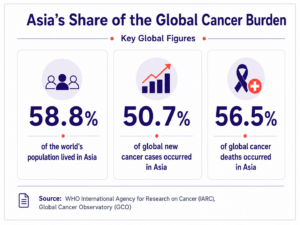
Asia represents approximately 58.8% of the world’s population. In 2024, Asia accounted for nearly 10.5 million new cancer cases, accounting for 50.7% of the global total. It also recorded approximately 5.5 million cancer deaths—56.5% of all cancer deaths worldwide.
The larger share of deaths than new cases does not have a single explanation. It highlights the need to examine differences in cancer types, stage at diagnosis, access to timely diagnosis and treatment, and survival after diagnosis across Asia.
Which Cancers Are Shaping the Burden in Asia?
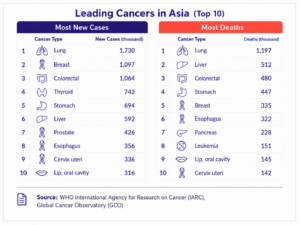
Lung cancer placed the greatest burden on Asia, ranking first in both new cases and deaths. Breast and colorectal cancers ranked second and third among newly diagnosed cancers.
Other cancers show important differences between incidence and mortality. Thyroid cancer ranked fourth in new cases but contributed a much smaller share of cancer deaths. Liver cancer, by comparison, ranked sixth in new cases but was the second-leading cause of cancer death. Stomach cancer ranked fifth in new cases and fourth in deaths.
These differences help identify cancers that are common, cancers that are especially deadly and areas where further research may have the greatest potential to improve outcomes.
Where Unmet Needs Remain
Look closely at Asia’s leading causes of cancer death, and a pattern emerges: five of the top seven — liver (2nd), colorectal (3rd), stomach (4th), esophagus (6th), and pancreatic (7th) — are cancers of the digestive system, often grouped within gastrointestinal (GI) oncology.
Several ranked considerably higher in deaths than in new cases, particularly liver, esophageal, and pancreatic cancer, which underscores the serious mortality burden associated with cancers that can be difficult to detect early and treat effectively.
This is where continued research matters most, not only to develop better treatments but also to improve prevention, identify cancer earlier, and understand why outcomes vary among populations.
Living With and Beyond Cancer
Cancer’s impact extends beyond diagnosis and active treatment. In 2024, nearly 24.7 million people across Asia were living within five years of a cancer diagnosis.
Behind that number are millions of individuals and families navigating medical information, treatment decisions, side effects, follow-up care and the uncertainty of living with or beyond cancer. Caregivers often travel this journey alongside them, carrying their own practical and emotional responsibilities.
The Path toward Better Outcomes
A global study has estimated that nearly half—48% of cancer deaths could potentially have been avoided. Approximately one-third could have been prevented by addressing major risk factors, while a further 14% could have been avoided through earlier detection and curative treatment.
These findings show that reducing cancer incidence and mortality will not depend on one breakthrough alone. Prevention, early detection, effective treatment, equitable access and continued research must work together.
Understanding the burden is the first step toward changing it. Stay informed through Asian Fund for Cancer Research Limited and share this article to help bring greater attention to cancer prevention, research and unmet needs across Asia.
Source:
Sung H, Filho AM, Laversanne M, Ferlay J, Siegel RL, Soerjomataram I, Jemal A, Bray F (2026). Global cancer statistics 2024: GLOBOCAN estimates of incidence and mortality worldwide for 34 cancers in 186 countries. CA Cancer J Clin. doi:10.3322/caac.70090
Ervik M, Laversanne M, Lam F, Colombet M, Ferlay J, Filho AM, Bray F (2026). Global Cancer Observatory: Cancer Today (2024 estimates, version 1.0). Lyon, France: International Agency for Research on Cancer. Available from: https://gco.iarc.who.int/today